

Human Neurogenic locus notch homolog protein 4 (NOTCH4) ELISA Kit
Price on request
| SKU | Price | Quantity |
|---|---|---|
| HUEB2353 | Price on request |
Description
A sandwich-format colorimetric immunoassay from Assay Genie enables quantitative detection of Neurogenic locus notch homolog protein 4 (NOTCH4) in human biological samples. Validated sample types include serum, plasma, tissue homogenates, cell culture supernates and other biological fluids. The assay is specific for natural and recombinant human NOTCH4, is reactive with human samples, and is intended for research use only, supporting work in developmental biology.
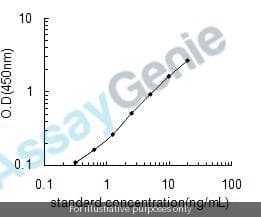
Performance characteristics include a detection range of 0.312-20ng/mL and a sensitivity of 0.1ng/mL, with an intra-assay CV of 3.4% and inter-assay CV of 7.6%. Linearity has been assessed in serum, EDTA plasma and heparin plasma across dilutions of 1:2 to 1:16. Recovery averages 97% for serum (range 91-103%) and 99% for plasma (range 93-105%). Recognised target synonyms include Notch 4 and INT3.
NOTCH4 functions as a receptor for the membrane-bound ligands Jagged1, Jagged2 and Delta1 to regulate cell-fate determination. Upon ligand activation, the released notch intracellular domain (NICD) forms a transcriptional activator complex with RBPJ/RBPSUH and activates genes of the enhancer of split locus, influencing differentiation, proliferation and apoptotic programs. The protein may also regulate branching morphogenesis in the developing vascular system. It is highly expressed in the heart, moderately in the lung and placenta, and at low levels in liver, skeletal muscle, kidney, pancreas, spleen, lymph node, thymus, bone marrow and fetal liver, with no expression was seen in adult brain or peripheral blood leukocytes. NOTCH4 belongs to the NOTCH family, and 3 human isoforms are produced by alternative splicing.
Other customers also viewed

Human MIP 3b/
CCL19 ELISA Kit Price on request

Human CXCL1/
GRO alpha ELISA Kit Price on request

Human CD26/
DPP4 ELISA Kit Price on request

Human Clusterin ELISA Kit
Price on request

Human ALCAM/
CD166 ELISA Kit Price on request

Human CXCL11 ELISA Kit
Price on request

Human IL-18 ELISA Kit
Price on request

Human Lipocalin-2/
NGAL ELISA Kit Price on request

Human EGF ELISA Kit
Price on request

Human LOX-1/
OLR1 ELISA Kit Price on request