

Anti-MAPK14 Antibody
Price on request
| SKU | Price | Quantity |
|---|---|---|
| A34940-100 | Price on request |
Description
This description has not been verified against the manufacturer's datasheet. Check the datasheet before you order, or ask us to confirm a specification. Ask us to confirm
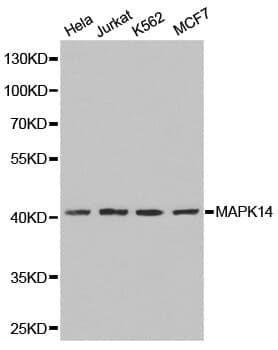
Generated in rabbit as an unconjugated polyclonal reagent, this Antibodies.com primary antibody targets MAPK14 (also called p38α MAPK), a serine/threonine kinase central to cellular stress and inflammatory signaling pathways. The 100 µl aliquot supports Western blot, immunohistochemistry, and immunofluorescence workflows on samples derived from human, mouse, and rat sources, giving laboratories a single reagent that spans multiple model systems and tissue types.
MAPK14 sits at the hub of the classical MAP kinase cascade, where it is activated by upstream kinases MKK3 and MKK6 in response to cytokines, UV exposure, and osmotic shock, and in turn phosphorylates substrates such as ATF2, MEF2C, and MAPKAP kinase 2. Researchers studying signal transduction, apoptosis regulation, and cytokine-driven inflammation rely on consistent detection of total and phosphorylated MAPK14 across cell lysates and fixed tissue sections. As an unconjugated reagent, the antibody is compatible with HRP, biotin, fluorophore, or alkaline phosphatase secondary detection systems, allowing protocol-specific optimization without re-titration of the primary.
Recommended applications include Western blot detection of the approximately 38 kDa band characteristic of p38α, immunofluorescence visualization of cytoplasmic and nuclear MAPK14 pools, and immunohistochemistry on formalin-fixed paraffin-embedded tissue. The polyclonal format recognizes multiple epitopes, which can be valuable when probing kinase isoforms or post-translational modifications. Aliquoting on receipt and limiting freeze-thaw cycles helps preserve reactivity across long-running studies, and full storage and handling conditions should be confirmed on the product insert prior to first use.
Other customers also viewed

Anti-PIGR Antibody [7C1] - Identical to Abcam (ab170321)
Price on request
Anti-PIGR Antibody [7C1] - Identical to Abcam (ab170321)
Price on request
Anti-FCAMR Antibody [10C4] - Identical to Abcam (ab170491)
Price on request
Anti-His Tag Antibody [KT111]
Price on request
Anti-IgE Antibody [1A2]
Price on request
Anti-CR1 Antibody [KT23]
Price on request

Anti-IgE Antibody (HRP) [1A2] - Identical to Abcam (ab106493) and Bio-rad (MCA2116P)
Price on request

Anti-IgM Antibody (HRP) [KT38] - Identical to Abcam (ab106742)
Price on request
Anti-IgM Antibody [KT38]
Price on request
Anti-IgE Antibody [1A2]
Price on request