

Anti-EYFP Mouse Antibody
Price on request
| SKU | Price | Quantity |
|---|---|---|
| A34593-100 | Price on request |
Description
This description has not been verified against the manufacturer's datasheet. Check the datasheet before you order, or ask us to confirm a specification. Ask us to confirm
This mouse polyclonal antibody from Antibodies.com specifically recognizes Enhanced Yellow Fluorescent Protein (EYFP), a yellow-shifted GFP variant derived from Aequorea victoria. The reagent is supplied as 100 µL of unconjugated antiserum and is intended for research use only in laboratories tracking fluorescent-protein reporters.
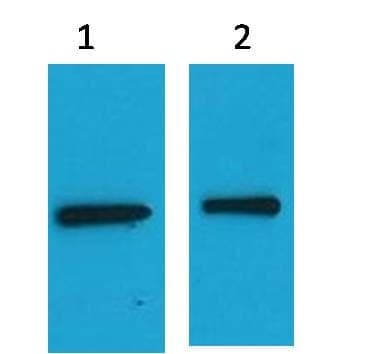
The antibody is validated for Western blot (WB), immunohistochemistry (IHC), and immunofluorescence (IF), making it useful for confirming EYFP-tagged fusion constructs across protein lysates, fixed tissue sections, and cultured-cell imaging. As a polyclonal reagent, it provides broad coverage of the EYFP primary sequence, which can help detect partially denatured epitopes or conformationally sensitive fusion partners. The unconjugated format leaves reporter choice to the end user, who can couple the antibody to HRP, biotin, Alexa Fluor dyes, or other preferred labels to fit their existing immunodetection workflows.
Common applications include verifying transgene expression in cells engineered with EYFP reporters, localizing EYFP fusion proteins in tissue by IHC, and probing EYFP band size on Western blots alongside molecular weight markers. Because the antibody is raised in mouse, secondary antibody selection should be planned accordingly, and care should be taken on mouse-derived samples to avoid cross-reactivity with endogenous immunoglobulins.
Each vial of the Antibodies.com anti-EYFP reagent ships at a working volume suited to multiple staining and blotting experiments, supporting standard immunodetection protocols in molecular biology, cell biology, and neuroscience laboratories where EYFP or EYFP-fusion constructs are routinely expressed.
Other customers also viewed

Anti-PIGR Antibody [7C1] - Identical to Abcam (ab170321)
Price on request
Anti-PIGR Antibody [7C1] - Identical to Abcam (ab170321)
Price on request
Anti-FCAMR Antibody [10C4] - Identical to Abcam (ab170491)
Price on request
Anti-His Tag Antibody [KT111]
Price on request
Anti-IgE Antibody [1A2]
Price on request
Anti-CR1 Antibody [KT23]
Price on request

Anti-IgE Antibody (HRP) [1A2] - Identical to Abcam (ab106493) and Bio-rad (MCA2116P)
Price on request

Anti-IgM Antibody (HRP) [KT38] - Identical to Abcam (ab106742)
Price on request
Anti-IgM Antibody [KT38]
Price on request
Anti-IgE Antibody [1A2]
Price on request