

Anti-ERK1/2 (D196) Antibody
Price on request
| SKU | Price | Quantity |
|---|---|---|
| A27043-50 | Price on request |
Description
This description has not been verified against the manufacturer's datasheet. Check the datasheet before you order, or ask us to confirm a specification. Ask us to confirm
Raised in rabbit against a synthetic peptide corresponding to a region surrounding residue D196 of human ERK1, this polyclonal reagent recognizes both extracellular signal-regulated kinase isoforms: ERK1 (MAPK3, approximately 44 kDa) and ERK2 (MAPK1, approximately 42 kDa). The ERK1/2 kinases sit at the core of the canonical RAS-RAF-MEK-ERK signaling cascade, transmitting signals from activated receptor tyrosine kinases, G-protein-coupled receptors, and integrins to control cell proliferation, differentiation, and survival. Phosphorylation at the Thr202/Tyr204 (ERK1) and Thr185/Tyr187 (ERK2) TEY motif is the established marker of pathway activation that researchers track in nearly every MAPK-focused study.
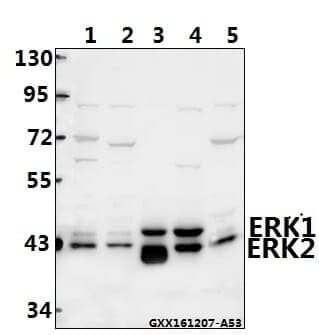
Provided by Antibodies.com as a 50 µl aliquot at 1 mg/ml in phosphate buffered saline with 15 mM sodium azide at approximately pH 7.2, the antibody is unconjugated and validated for western blot and immunofluorescence on human, mouse, and rat samples. In western blot, the reagent reveals the characteristic ERK1/ERK2 doublet near 42-44 kDa, while in immunofluorescence it produces the expected cytoplasmic staining pattern that redistributes toward the nucleus after pathway activation by stimuli such as EGF, serum, or phorbol esters. Because sodium azide is included as a preservative, the formulation should not be used for live-cell labeling.
Researchers commonly deploy this Antibodies.com antibody to compare basal versus stimulated ERK1/2 phosphorylation across treatment conditions, to monitor pathway inhibition by MEK inhibitors, and to assess total ERK1/2 levels as a loading reference alongside phospho-specific antibodies. The polyclonal format broadens epitope coverage, which is helpful when probing the phosphorylated forms of the kinases that may be masked in monoclonal antibody epitopes. Aliquot upon receipt, store refrigerated, and protect from light to preserve activity across multiple freeze-thaw cycles.
Other customers also viewed

Anti-PIGR Antibody [7C1] - Identical to Abcam (ab170321)
Price on request
Anti-PIGR Antibody [7C1] - Identical to Abcam (ab170321)
Price on request
Anti-FCAMR Antibody [10C4] - Identical to Abcam (ab170491)
Price on request
Anti-His Tag Antibody [KT111]
Price on request
Anti-IgE Antibody [1A2]
Price on request
Anti-CR1 Antibody [KT23]
Price on request

Anti-IgE Antibody (HRP) [1A2] - Identical to Abcam (ab106493) and Bio-rad (MCA2116P)
Price on request

Anti-IgM Antibody (HRP) [KT38] - Identical to Abcam (ab106742)
Price on request
Anti-IgM Antibody [KT38]
Price on request
Anti-IgE Antibody [1A2]
Price on request