

Human Lysophosphatidylcholine Acyltransferase 1 ELISA Kit
Price on request
| SKU | Price | Quantity |
|---|---|---|
| A6739-48 | Price on request |
Description
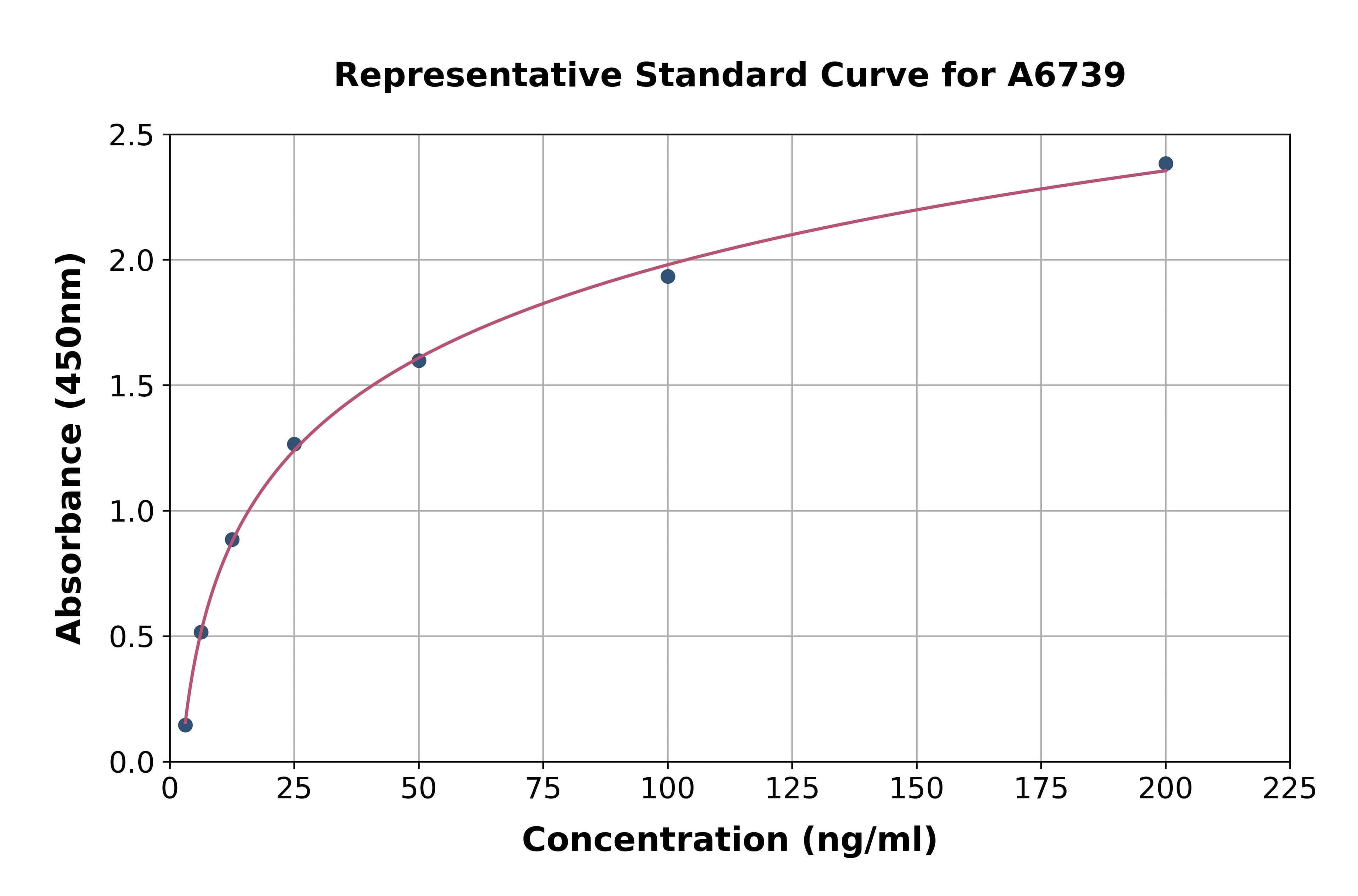
Antibodies.com provides a sandwich Enzyme-Linked Immunosorbent Assay (sELISA) intended for the in vitro quantitative determination of human LPCAT1 in serum, plasma, tissue homogenates or other biological fluids. The procedure employs a pre-coated microplate onto which an antibody specific for LPCAT1 has been immobilised. Standards and test samples are added to the wells and any LPCAT1 present is captured by the immobilised antibody. After incubation and washing, a Biotinylated Anti-LPCAT1 Antibody is added, followed by an HRP-Avidin conjugate. TMB substrate is then used to visualise the HRP enzymatic reaction; the product appears blue and turns yellow upon addition of acidic stop solution. Absorbance is read at 450 nm in a microplate reader and the LPCAT1 concentration is calculated by reference to a standard curve.
The assay is quantitative with a reported sensitivity of <1.15 ng/ml and an assay range of 3.12–200 ng/ml. Detection is colourimetric on a pre-coated microplate (12 × 8 well strips) and the total assay time is approximately 4 hours 30 minutes. Reactivity is limited to human samples.
Recovery performance across three sample matrices, based on the manufacturer description, is reported as follows: serum (n=5) range 80%–102% with a mean of 91%; EDTA plasma (n=5) range 81%–101% with a mean of 91%; heparin plasma (n=5) range 80%–89% with a mean of 84%. Dilution linearity is reported at 1:2, 1:4, 1:8 and 1:16 dilutions for the same sample types, with serum values of 87–91%, 87–107%, 74–101% and 92–97% respectively; EDTA plasma values of 90–105%, 84–101%, 90–101% and 79–108%; and heparin plasma values of 84–95%, 92–105%, 82–105% and 89–91%. Kit components should be stored at +4°C or -20°C as instructed, and the kit should not be used past its expiration date.
Other customers also viewed

Human Activin A ELISA Kit
Price on request
Human ACE ELISA Kit
Price on request
Mouse Activin A ELISA Kit
Price on request
Human Adiponectin ELISA Kit
Price on request
Human Angiogenin ELISA Kit
Price on request
Rat Activin A ELISA Kit
Price on request
Mouse Adiponectin ELISA Kit
Price on request
Human Angiopoietin 2 ELISA Kit
Price on request
Human BAFF ELISA Kit
Price on request
Mouse BDNF ELISA Kit
Price on request