

Bovine Cyclophilin B ELISA Kit
Price on request
| SKU | Price | Quantity |
|---|---|---|
| A4287-48 | Price on request |
Description
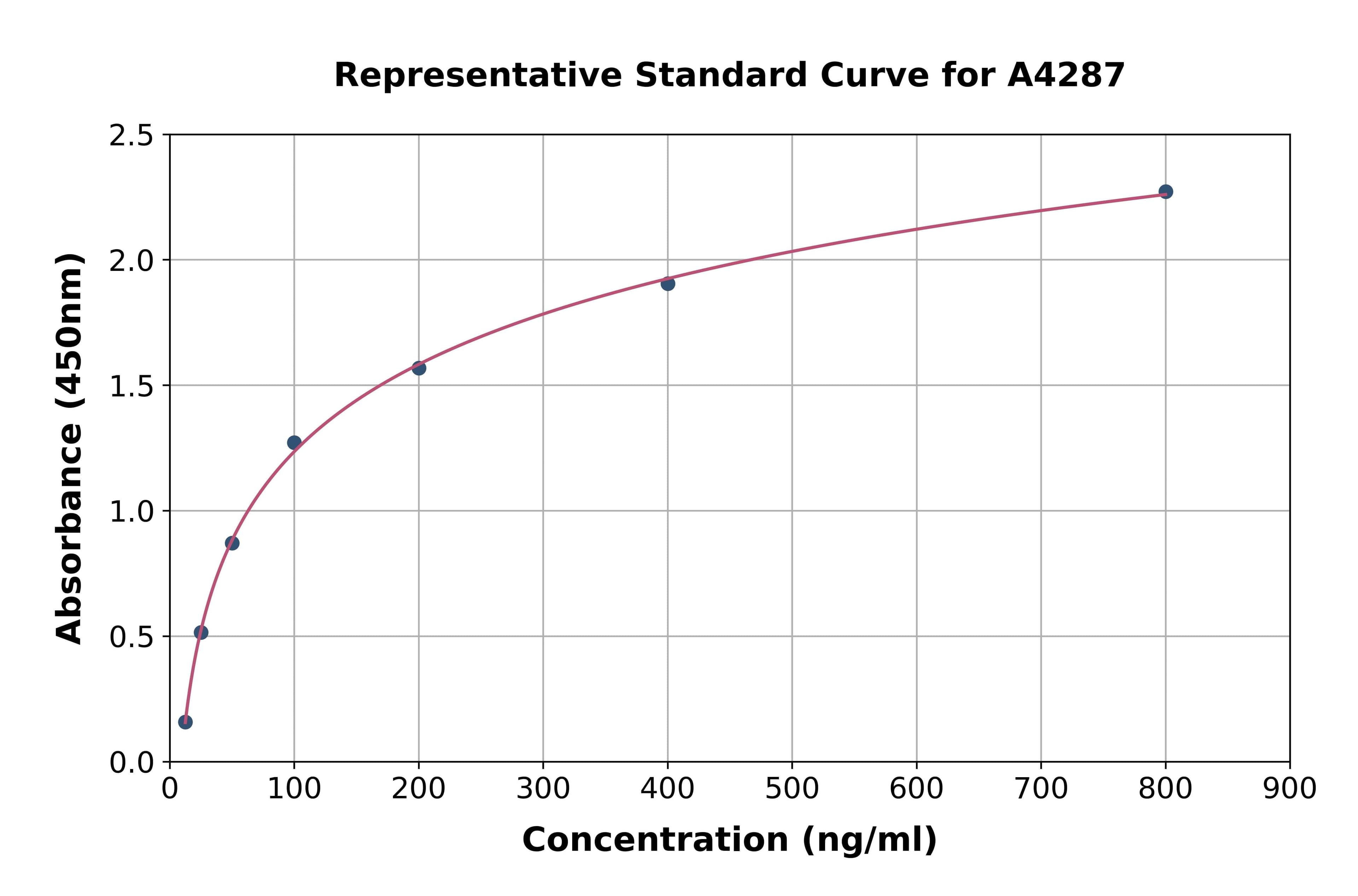
The Antibodies.com Bovine Cyclophilin B ELISA Kit is a sandwich Enzyme-Linked Immunosorbent Assay (sELISA) designed for the in vitro quantitative determination of bovine Cyclophilin B in serum, plasma, tissue homogenates, cell lysates, cell culture supernates and other biological fluids [S1, S2]. The assay employs the sandwich enzyme immunoassay technique, using a microtiter plate pre-coated with an antibody specific for Cyclophilin B. Standards and test samples are added to the wells and bound by the immobilized antibody, followed by incubation with a Biotinylated Anti-Cyclophilin B Antibody and an HRP-Avidin conjugate. TMB substrate is used to visualise the enzymatic reaction, producing a blue product that turns yellow upon addition of the acidic stop solution; the density of yellow is proportional to the target concentration, which is calculated from the O.D. absorbance read at 450 nm against a standard curve [S1, S2].
Reported performance figures include a measuring range of 12.5–800 ng/ml and a sensitivity of 5.2 ng/ml [S1, S2]. The assay is run on a pre-coated 96-well microplate (12 x 8 well strips) with a total assay time of 4h 30m and is read on a colourimetric microplate reader [S1]. Spike-and-recovery values for neat samples were an average of 91% for serum (range 80–102%), 90% for EDTA plasma (range 81–100%) and 84% for heparin plasma (range 80–89%) [S1]. Dilution linearity across 1:2 to 1:16 dilutions fell within overall ranges of 74–107% for serum, 79–108% for EDTA plasma and 82–105% for heparin plasma [S1].
Kit components supplied include a pre-coated 96-well microplate, lyophilized standard, Detection Solution A, Detection Solution B, 30X Wash Buffer, Sample Dilution Buffer, TMB Substrate, Stop Solution and plate sealers; components are stored between +4°C and -20°C as specified in the instructions [S1, S2]. The product is intended for research use only and is not for diagnostic or therapeutic use [S2].
Other customers also viewed

Human Activin A ELISA Kit
Price on request
Human ACE ELISA Kit
Price on request
Mouse Activin A ELISA Kit
Price on request
Human Adiponectin ELISA Kit
Price on request
Human Angiogenin ELISA Kit
Price on request
Rat Activin A ELISA Kit
Price on request
Mouse Adiponectin ELISA Kit
Price on request
Human Angiopoietin 2 ELISA Kit
Price on request
Human BAFF ELISA Kit
Price on request
Mouse BDNF ELISA Kit
Price on request